

Myanmar’s $600 Million Drug Bust Highlights Ongoing Crisis
Myanmar’s $600 Million Drug Bust Highlights Ongoing Crisis
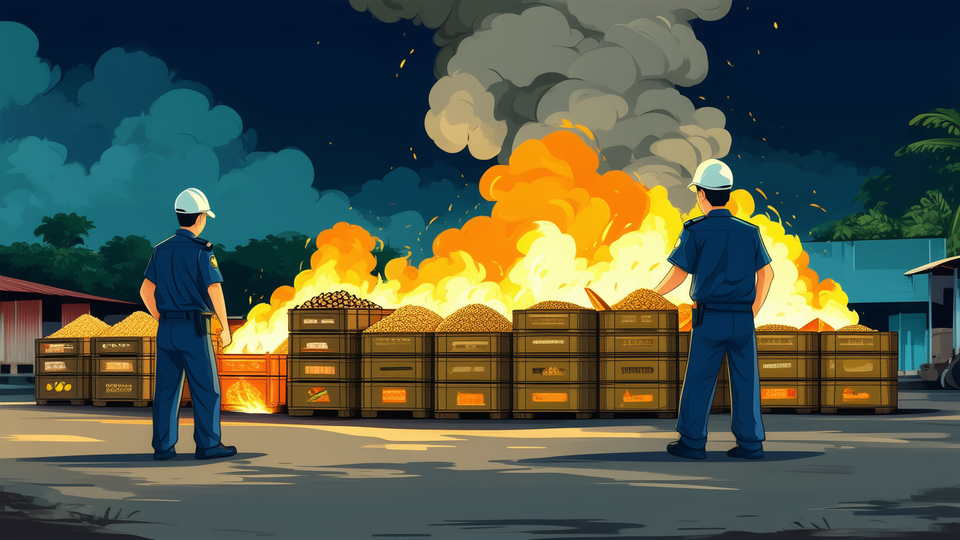
On June 26, 2026 thick clouds of black smoke rose over the outskirts of Yangon as authorities incinerated more than 50 tons of seized illegal drugs. The haul included heroin, opium, ketamine, crystal meth, marijuana and other narcotics, carrying an estimated street value of about $600 million. In Yangon alone, police reported $321 million worth of 31 different drug types were set ablaze, while similar ceremonies took place in Mandalay and Taunggyi as part of the United Nations International Day Against Drug Abuse.
The operation followed a series of raids earlier in the year that targeted 12 drug‑production sites across northern Shan State. These raids, claimed by the military government as the largest ever, resulted in the seizure of vast quantities of narcotics and the equipment needed to manufacture them. Officials said the value of drugs destroyed this year more than doubled that of the previous year, a stark indication of the expanding scale of Myanmar’s illicit trade.
Myanmar’s drug problem is deeply intertwined with its political instability. Since the military seized power in 2021, the nation has descended into a civil war involving the junta, pro‑democracy forces and numerous ethnic armed groups. The conflict has created fertile ground for drug production, providing funding for militias and limiting central government control over remote regions. The Ta’ang National Liberation Army, once a major player in the drug trade, announced a separate $5.5 million seizure in its controlled area, highlighting the fragmented nature of enforcement across the country.
Health experts warn that the widespread availability of heroin, methamphetamine and other substances fuels a growing public‑health crisis, both within Myanmar and across neighboring countries in Southeast Asia. By destroying these supplies, authorities aim to cut the flow of drugs that devastate families, strain healthcare systems and contribute to addiction and overdose deaths. While the incineration event is symbolic, it also reflects a strategic effort to disrupt the financial lifelines of armed groups that rely on narcotics sales.
The international community has long called for stronger action against Myanmar’s drug trade. The United Nations, regional partners and NGOs emphasize that curbing production requires not only law‑enforcement measures but also development initiatives that address poverty, education and alternative livelihoods. Sustainable solutions must balance security operations with health‑focused interventions, ensuring that those displaced from the drug economy receive support to transition into legitimate work.
In the months ahead, Myanmar’s government plans to continue high‑profile destruction ceremonies, signaling its commitment to combatting the narcotics threat. However, lasting progress will depend on a broader peace process that reduces armed conflict, curtails militia financing, and promotes public‑health strategies to treat addiction. The $600 million drug bust serves as both a milestone of enforcement success and a reminder of the complex challenges that remain.





