

Supreme Court Signals Possible Shift on Bruen Gun Rights Test
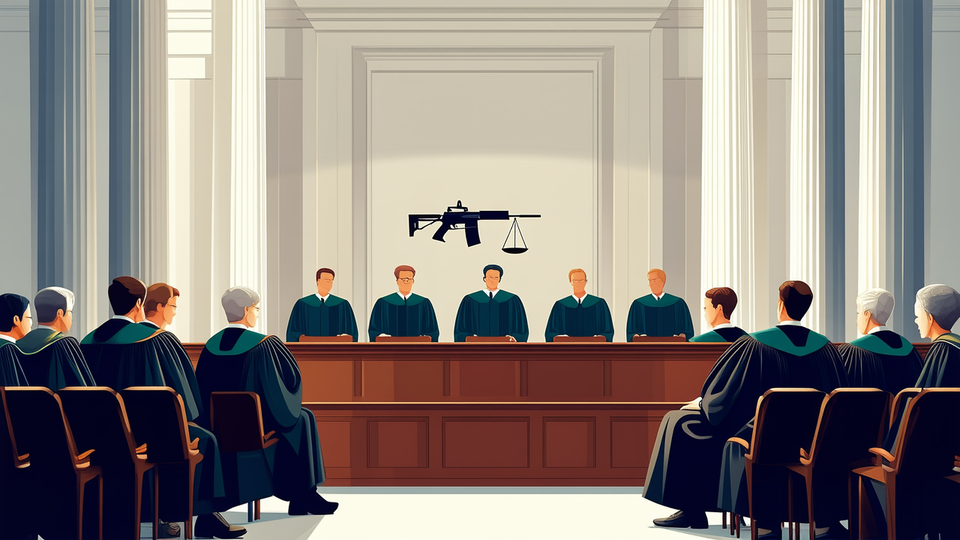
Supreme Court Signals Possible Shift on Gun Rights Test
On June 21, 2026 the United States Supreme Court issued a unanimous decision in a case involving Ali Hemani, a U.S.–Pakistani citizen charged with illegal firearm possession while regularly using marijuana. The ruling affirmed Hemani’s right to keep a gun, rejecting the government’s argument that habitually using a controlled substance automatically disqualifies a person under the federal law that bars “unlawful users of or addicted to any controlled substance.”
Immediately after the opinion was released, Justice Ketanji Brown Jackson called for the Court to reconsider the landmark “Bruen” test that has guided Second Amendment jurisprudence since the 2022 decision in New York State Rifle & Pistol Association v. Bruen. In a separate statement, Justice Jackson, joined by Justice Sonia Sotomayor, described the Bruen approach as “unworkable” because it forces judges to sift through centuries‑old historical evidence to resolve modern gun‑policy questions.
Jackson argued that the historic analogues used in Bruen often date back to a different era, when firearms were aimed at protecting property in agrarian societies, not at addressing today’s concerns about public safety, mental health, or substance use. She suggested that the Court might need to “retire the failed Bruen experiment” and return to an analysis that focuses on Congress’s intent and the contemporary purposes of gun regulations.
The call for a new standard resonated with legal scholars and advocacy groups. Jonathan Lowy, president of Global Action on Gun Violence, noted that the 2026 decision reflects evolving public attitudes toward marijuana, emphasizing that “twenty‑first‑century gun violence can’t be solved with eighteenth‑century solutions.” Similarly, Justice Neil Gorsuch highlighted the difficulty of drawing fair historical parallels between modern drug use and eighteenth‑century “habitual drunkards.”
If the Court adopts a revised framework, the impact could be far‑reaching. A focus on congressional purpose would give lawmakers greater flexibility to craft regulations that address contemporary risks such as mental health crises, domestic violence, and substance abuse, while still respecting the constitutional guarantee to keep and bear arms. It could also provide clearer guidance for lower courts, reducing the inconsistent and arbitrary outcomes that have emerged under the Bruen test.
Critics of the Bruen approach argue that a return to a “means‑ends” analysis would better balance individual rights with public safety, while still allowing the Second Amendment to function as a safeguard against tyranny. Supporters of the status quo caution that any shift must not erode the core protections that the amendment provides.
As the nation watches this legal debate unfold, the Supreme Court’s willingness to revisit its own precedent signals a responsive and adaptable judiciary. Whether the Court ultimately modifies the Bruen test remains uncertain, but the discussion underscores the importance of aligning historic constitutional principles with the realities of modern American life.
In the months ahead, lawmakers, advocates, and courts alike will be closely monitoring the Court’s next steps. A revised standard could reshape the legal landscape of gun regulation, potentially leading to more nuanced policies that protect both constitutional freedoms and public safety.





