Florida poll shows Donalds and Moody ahead but with tighter margins
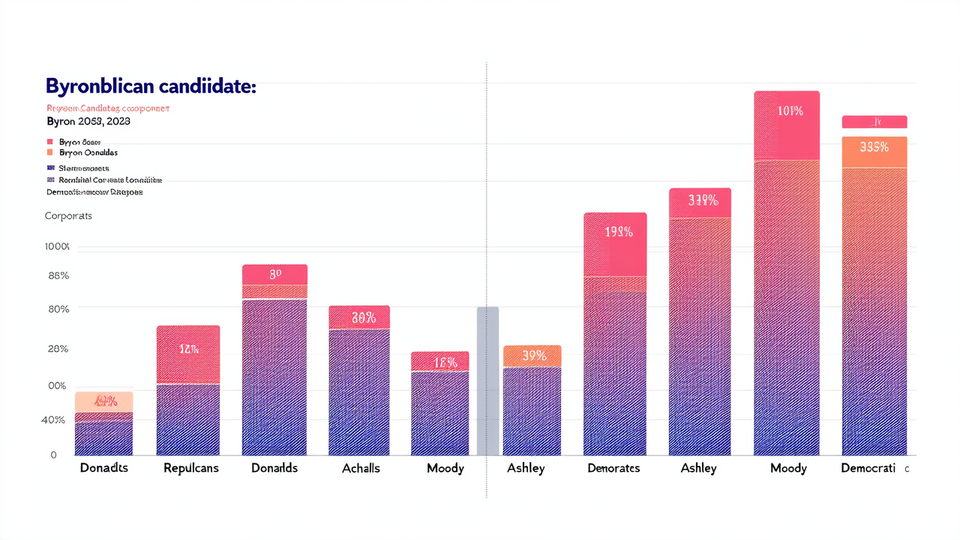
A Mason‑Dixon poll released early October shows Republican incumbents Byron Donalds and Ashley Moody maintaining leads in Florida’s governor and U.S. Senate contests, but the margins are narrower than in previous surveys, indicating a more competitive environment.
Donalds captured 48% of the vote compared with 41% for Democrat David Jolly, a seven‑point advantage, while Moody earned 50% against Democrat Angie Nixon’s 40%, a ten‑point gap. Both Republican candidates also outperformed their opponents among Hispanic voters, with Donalds at 48% to Jolly’s 43% and Moody at 47% to Nixon’s 40%.
Undecided voters remain a factor: 10% of respondents were still deciding in the governor’s race and 8% in the Senate contest. Among Hispanic voters, 8% were undecided for governor and 9% for Senate. Independents leaned toward the Democratic challengers, with Jolly leading Donalds 47% to 28% and Nixon ahead of Moody 41% to 35%, though both contests retained a sizable undecided share.
Gender and age breakdowns reveal further nuances. Men favored Donalds 55% to 33% over Jolly and Moody 57% to 31% over Nixon. Women favored the Democrats, with Jolly at 49% to Donalds’ 41% and Nixon at 48% to Moody’s 43%. Younger voters (ages 18‑34) showed a narrow lead for the Democrats in the governor’s race, while the Senate race saw Nixon ahead of Moody 51% to 39% among the same cohort.
Party affiliation strongly predicts support: 87% of registered Republicans backed Donalds, while 85% of registered Democrats supported Jolly. Moody enjoyed 91% Republican backing, with 87% of Democrats backing Nixon. However, Democrats attracted 10% of Republican voters in the governor’s race, and Republicans gave 4% to the Democratic Senate candidate.
The poll also measured issue importance, with inflation and cost of living cited by 30% of respondents as the top influence on voting decisions, followed by direction of the state or country (17%) and immigration enforcement (16%).
Survey methodology involved live telephone interviews with 625 registered Florida voters conducted between September 28 and October 1. Results carry a ±4‑point margin of error at the 95% confidence level, with larger uncertainty for smaller demographic groups.